

Original Dungeons & Dragons began publication with its three-volume boxed set (1974) and was most famously supported with four Supplements (1975-1976). Depending on what you count, there were somewhere between a half-dozen publications for OD&D and triple that number. (Edition boundaries were weak when no one had ever produced a new edition before!)
Advanced Dungeons & Dragons First Edition (which was never called that while it was being published) contributed to the fuzziness of edition boundaries by taking two years to produce the three core books of Monster Manual (1977), Players Handbook (1978), and Dungeon Masters Guide (1979). Which meant that people mixed the first volumes with OD&D or Basic Dungeons & Dragons (1977), demonstrating more edition fuzziness. AD&D 1e then continued through somewhere in excess of 100 books, published up through 1988. (And maybe more.)
The timeline.designers-and-dragons.com website now includes a graphical view of the OD&D and AD&D 1e products, laid out in chronological order. That timelines also acts as visual table of contents for Designers & Dragons Origins Volumes I through II, which contain the product histories for all those publications. (And of course Designers & Dragons Origins is now on Backerkit.)
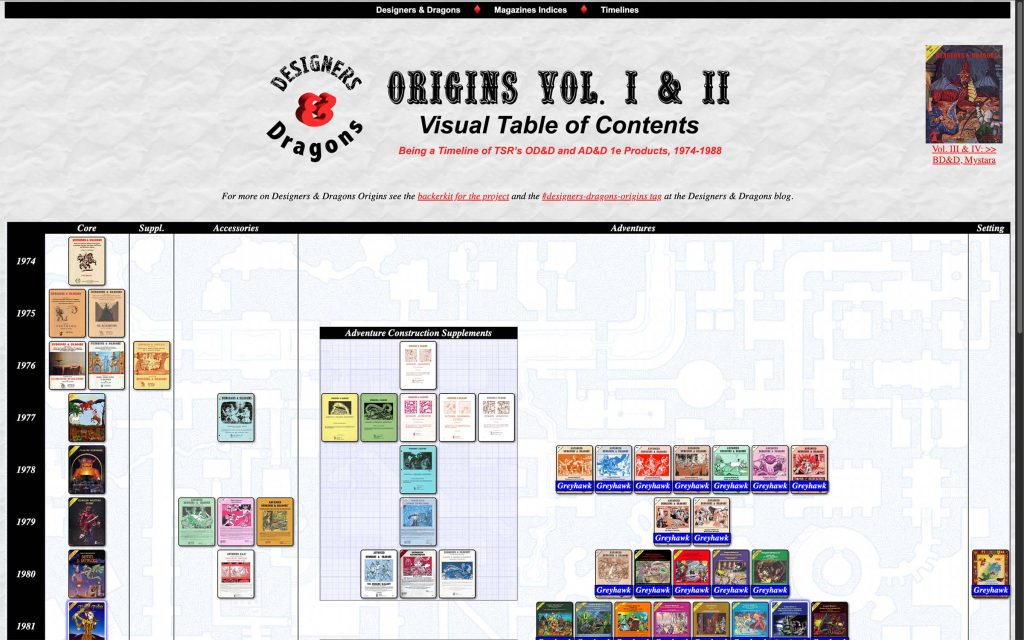
Laying products out in a graphical timeline can reveal patterns of publication. Here’s some thoughts on what the OD&D and AD&D 1e timelines reveal:
D&D’s Graphic Design Was Constantly Evolving. The rapid evolution of D&D‘s graphic design is astounding, starting with those little digest-sized books in 1974-1976, then jumping to the first rather plain accessories, from 1976-1978. Next to those, the Monster Manual (1977), with its full-color, full-page cover artwork, was astounding, especially if you consider its robust binding too. So were the adventures from 1978 onward, which offered a new level of graphic design. But AD&D was constantly evolving. Full-color adventure covers appeared in 1980 and a revamped branding design in 1983. Full-page cover art debuted with C3: The Lost Island of Castanamir (1984), but became increasingly common starting in 1987, with the debut of the Forgotten Realms line. This all speaks to the constant innovation of TSR, but also to its improving financials, which allowed for the production of ever better-looking books.
TSR Didn’t Think that Players Wanted Adventures at First. There’s a surprising gap of four years from OD&D (1974) to the first standalone adventure. In fact, if you look at the timeline, you see that the first thing TSR tried was do-it-yourself books like geomorphs and random tables of monsters and treasures. TSR took some real convincing to produce pre-packaged adventures, because they thought players wanted to do it themselves!
But Then Adventures Was Almost Everything TSR Produced! Once TSR was convinced to produce adventures, it became the vast majority of their production, topping out at 94% in 1984. Oh sure, there were between 0-2 hardcovers every year, as well as the occasional accessory or setting book, but D&D never would see this much adventure production again. (At least not as a percentage: the product release count during the AD&D 2e era was outrageous.)
Greyhawk Was the Heart of the Game Until 1982. Sort of. The timeline clearly shows Greyhawk overwhelming the early D&D adventure production. However, that’s only sort of true as the earliest adventures like the Giants series (1978) and S1: Tomb of Horrors (1978) were very setting light. However, from 1979-1982, TSR produced almost 20 adventures that were firmly set in Greyhawk. What’s even more obvious from the timeline is how quickly the Greyhawk focus tailed off starting in 1983. At first, generic adventures got the nod (some of which were later absorbed into new settings like the Forgotten Realms and Ravenloft), but by the time Dragonlance showed up in 1984, it was already all over for Greyhawk, at least at TSR, even if the setting was very long in its dying.
Aquaria Could Have Been a Contender. It’s remarkable to see Aquaria as a firm setting in 1982-1983. It really stands out against that sea of darker blue. Though its appearance was thanks to setting creator Frank Mentzer running the RPGA, which was publishing those adventures, you can certainly see that Aquaria could have become a major setting if not for Mentzer leaving TSR with Gygax a few years later.
One of These Things Is Not Like the Others. Alongside ~150 digests, books, and boxes, one series of products stands out: the Monster Card Sets (1982), a line of four products each consisting of 20 cards with a full-color picture of a monster on one side and stats on the back. It speaks to the continued innovation at TSR in 1982 and their willingness to make a pretty pricey, high-quality product. (Of course layoffs and near-bankruptcy were just around the corner.)
Production Exploded in 1983-1985. The jumps in production from 1983-1985 compared to earlier years are outstanding. Depending on whether you count the RPGA products (1982-1983), the self-produced TSR UK products (1984-1986), or just the TSR products proper, one of those years was a real record breaker. 9 AD&D products in 1981 and 8-11 in 1982 became 12-17 in 1983, 12-16 in 1984, 17-18 in 1985, and 18-19 in 1986. The change in hardcover production from one every two years from 1981-1984 to two per year in 1985-1987 is equally notable.
Dragonlance Was a Mini-Series. The red banners of Krynn clearly show it as a mini-series that ran from 1984-1986. From 1987-1988, production suddenly became very scattered because TSR didn’t know what to do with the line. It’s not obvious from the timeline, but the two Krynn products in 1987, Atlas of the Dragonlance World (1987) and Leaves from the Inn of the Last Home (1987) ,were both more fiction supplements than roleplaying supplements, leaving the roleplaying line entirely at sea for a whole year. Unfortunately, that would be the case pretty much forever: the only one who reliably knew what to do with Dragonlance after the initial chronicles was Margaret Weis Productions when they ran the product line from 2003-2008.
The Release of Setting Books Starting in 1987 Was a Major Innovation. From 1974-1986, TSR published an occasional setting book, but they were just one-and-done core books that overviewed the setting and then left adventures to fill in the details. The 1987 explosion of setting books for the Forgotten Realms was a major change (albeit one that was also occurring in the Mystaran Gazetteers). It was the first thing to challenge the dominance of adventures at TSR since their advent in 1978.
It Wasn’t The Only Innovation of the Year. You can’t look at 1987 without seeing how much adventures shrunk down while other categories innovated. That included those two fictional suplpements for Dragonlance and the first hardcovers that were based on settings (rather than just being rulebooks), then a year later you also get Dungeon Master’s Design Kit (1988), TSR’s first book of GM advice. A 12-18 month span is probably also how long it took for the entire design schedule to clear out after Gary Gygax left TSR at the end of 1985, which suggests that the innovation might have been abut new people making the high-level decisions.
By 1988, the Realms Had Stolen Greyhawk’s Crown. The 10 Realms books that TSR put out in 1988 were the most they’d ever produced for an AD&D setting, beating out 8 for Greyhawk way back in 1981 and Dragonlance’s few years that saw 5 books. The setting hadn’t become the phenomenon that it would in the AD&D 2e era, but this was another clear sign that the tides were changing at TSR, just like the innovations that spanned 1987-1988.
The AD&D 2e Transition Was Muddy. The timeline includes a few 1989 products with the “AD&D 2nd Edition” branding. That’s because many of the early “AD&D 2e” products were actually written with AD&D 1e rules! Most of those products were saved for the AD&D 2e history books anyway, but FR7: Hall of Heroes is an example of a release that was just so full of AD&D 1e rules (and with nothing to drag it over to the AD&D 2e side) that it had to be placed in the AD&D 1e volumes.
TSR Was Still Producing AD&D 1e Material in 1990! Perhaps even more surprising are the two 1990 books. Though they again use the “AD&D 2nd Edition” branding, these were decidedly AD&D 1e books, written to supplement AD&D 1e hardcovers! That demonstrates how weak the line was between editions even more than a decade after players were freely mixing OD&D, AD&D 1e, and BD&D. The obsession with whether old supplements would be usable with new game systems is much more one for the 21st century!
There’s another article coming, discussing some of the patterns depicted in the Basic D&D timeline. And if you’re interested in the histories of all the books depicted in the timelines, take a look at the Designers & Dragons: Origins project on Backerkit.