

Basic D&D originated in 1977 with the publication of the first Basic Dungeons & Dragons Set (1977), by J. Eric Holmes. At the time, it was just an attempt to make the OD&D (1974) rules more comprehensible. But when Tom Moldvay and David “Zeb” Cook, with Steve Marsh, published the new “B/X” edition (1981), Basic D&D became its own game system—the only one to carry D&D co-designer Dave Arneson’s name following the parallel publication of the AD&D line (1977-1979). Basic Dungeons & Dragons thereafter carved out its own corner of the D&D world as an introductory game system. When TSR iterated it further with Frank Mentzer’s “BECMI” edition (1983-1986) and Troy Denning and Timothy Brown’s black box (1991), their goal was constantly to provide an even better experience for new players.
Thanks to the foundational work of Moldvay & Cook and the continued oversight of Bruce Heard, who became the coordinator for the line in the later ’80s, Basic D&D also developed its own world: the Known World, which later became known as Mystara. Even after TSR decided that running a parallel Basic D&D line was too costly (and confusing!), Mystara was unique enough to continue on a few years more as an AD&D setting.
The timeline.designers-and-dragons.com site contains a visual timeline depicting all the Basic D&D products from 1977-1993, as well as the AD&D products that followed. This is also a visual table-of-contents for Designers & Dragons: Origins Volumes III & IV, which contains the histories of all 100+ products from the BD&D line. Designers & Dragons: Origins is currently on Backerkit.
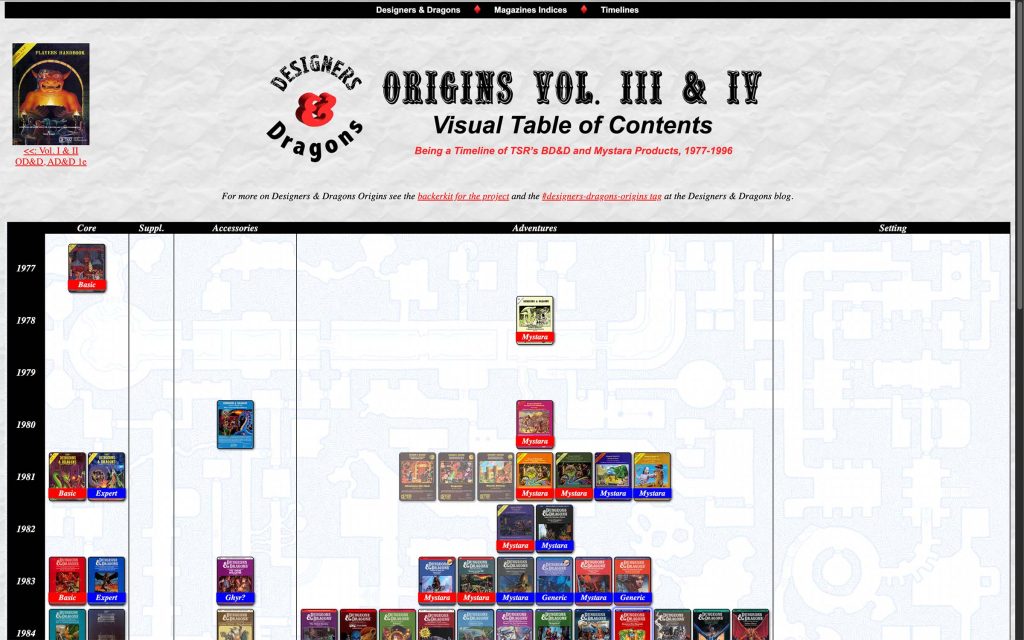
I love infographics because they reveal things that you might not recognize from a textual description of the same information. Here’s some of the things that I think are revealed from the Basic D&D timeline:
Holmes D&D Was Neglected. J. Eric Holmes’ Basic D&D came out in 1977, and it was barely supplemented: just two adventures and one set of character sheets over the course of the next three years! This is reflective of how Basic D&D was originally intended: as an clean-up of OD&D, and as an introduction to the AD&D rules that Gary Gygax was then working on, not as its own line. Except that the AD&D rules changed over the next few years of production. By the time they were fully published in 1979, Basic D&D was left out in the cold. That might have been its end: BD&D could have been a one-off oddity. Except TSR was increasingly selling to “munchkins”, not the college students who played its first games, and so an introductory game was needed to bring them in. Basic D&D was a perfect fit for that.
Basic D&D Came Of Its Own with B/X. The initial expansion of products after the publication of the B/X edition was a huge change from the minimal support for Holme D&D. It was still just a fraction of what came later with BECMI, but it clearly showed that Basic Dungeons & Dragons was now being treated as its own product line.
Again, Production Exploded in 1984. The AD&D line really exploded somewhere between 1983-1985, depending on whether you count partnered products at RPGA and TSR UK or not. For Basic D&D, you can more precisely point to the middle year: 1984. After 9 BD&D releases in 1983 (including the first two “BECMI” rule boxes), TSR knocked out 15 releases in 1984. BD&D production saw publication in that range through 1987 (which saw 17) before a rather abrupt change the next year.
There Were Only Four Years of High-Level Adventures. The Basic D&D line is well-remembered for its high-level “Companion”, “Master”, “and “Immortals” adventures. It’s astounding looking at the timeline to see they only lasted for four years, from 1984-1987. But sometimes that’s how innovation goes: even if it’s a flash in the pan, its memory extends far further.
Expert Was the Sweet Spot for Early BD&D. Though one might think that introductory adventures were the heart of Basic D&D play, there were actually far more Expert-level adventures published: 24 Expert-level adventures vs 12 Basic-level adventures. But looking at it logically, that shouldn’t be a surprise: Basic was levels 1-3 and Expert levels 4-14, so there was a lot more room for a lot more adventures at the Expert level, without them just going over the same ground. (Designers have also said that they felt the Expert levels were the sweet spot of D&D adventuring, not just D&D publication.)
1987-1989 May Have Been the Biggest Change Ever for any D&D Line. When you look at the years 1987-1988, the changes are astounding. Over the course of three years, the Basic D&D entirely dropped its adventure line, replaced it with a line of setting books, and then brought back adventures, but without the higher (“CMI”) levels, while also experimenting with a totally new sort of product: the Trail Maps. Maybe the shift from AD&D 2e to D&D 3e in 1999-2000 was bigger because of the total revamp to the game system, but maybe not: this was a foundational change to a line, and it was thanks to a single person: Bruce Heard.
Basic D&D’s Setting Books Were Groundbreaking. If it looks like the Known World Gazetteers came out of nowhere, they totally did. Bruce Heard didn’t just initiate the idea of setting-based splatbooks at TSR (in the wider industry, Judges Guild’s The Wilderlands, a number of sectors for Traveller, and a scattering of other larger scale products preceded them), but he pushed them to the fullest, reinventing the Gazetteers as Creature Crucibles and Hollow World supplements as the original books grew too numerous. The publication of a whole new category, containing 35 setting-based books over the next decade really says it all. (Yes, the Forgotten Realms did it too, but slightly trailing the Known World, and never in quite these numbers.)
Mystara was Briefly TSR’s Most Popular Setting. Speaking of numbers: Mystara was absolutely TSR’s most popular (or at least most numerously published) setting in the golden age covered in the first four Designers & Dragons: Origins books. Greyhawk topped out at 8 (adventure) books for the setting in 1981. The Forgotten Realms surpassed that with 10 books in 1988, half of them adventures, almost half of them setting, and one of them an accessory. Mystara saw at least 8 publications every year from 1984-1986, then hit 15 in 1987 (including the past of Blackmoor and its planar worlds). Making Mystara the most popular world that gets no attention at modern-day Wizards of the Coast (but tons from fans).
I expect to have more timelines in the future now that I’ve built out the CSS and website for it. If you’re interested in more history of Basic Dungeons & Dragons, be sure to take a look at the Designers & Dragons: Origins Backerkit, which ends in two days’ time.