

As I’ve written elsewhere, the product histories now available in Designers & Dragons: Origins started life as product histories for DriveThruRPG. I wrote the original articles from 2013-2017, but since 2020 I’ve been redeveloping them for publication in book form. This article is intended to give a bit of insight into what that redevelopment means.
I actually had a bit of a quandary figuring out which article to document in this way. A lot were too long and a lot had too many changes. I settled on N5: Under Illefarn (1987) fairly randomly, mainly because it’s one of the product histories available in the Adventurer’s Hoard preview available to backers. Moreso, at four pages long, it was a medium-sized history, and that’s in the range where histories didn’t undergo too extensive of revisions, unless there was a big new discussion of the product. In this case, I talked with Steve Perrin about the product in 2013 when I wrote the original product history, and there wasn’t a lot to add in 2021 when I revised this, because that was around when he passed away.
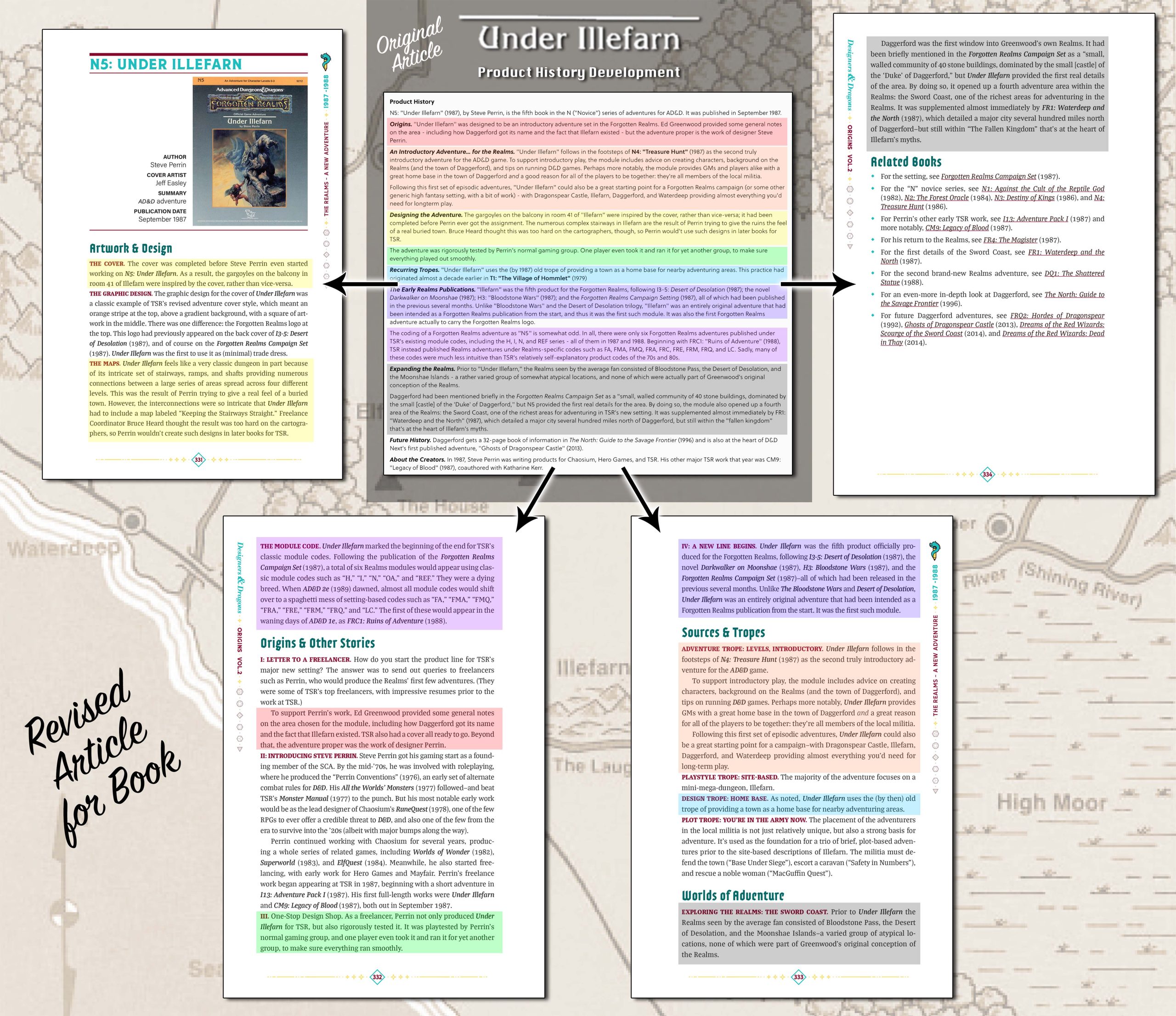
The image above has the original DriveThruRPG history in the middle, and then the four-page Designers & Dragons: Origins history surrounding it. You can click through if you’d like to make a word-by-word comparison, but I think the color-coded sections tell much of the story: each one shows where a topic was discussed in the original history and where it ended up in the new history (sometimes word-for-word, often slightly edited, occasionally largely rewritten).
Here’s some general notes on the process:
The Benefits of Book Publication are Obvious. Above everything else, book publication gives us the ability to present things better than on a text-focused website. Cris Viana has done a beautiful job with the layout, integrating cover image, my info block on the book, and colors. And, of course, a book allows us to present everything as a cohesive whole too.
But there’s also a lot more that’s changed beyond the presentation of the articles.
The Heart of Designers & Dragons: Origins is the Organization. Early in the ’10s, I purchased a trio of books by Lars Pearson called I, Who, which were “unauthorized” guides to the Doctor Who novels. Each book contained many articles on individual Doctor Who novels, and each article was divided into recurring topics for discussion. It’s always hard to say where our inspirations come from, but I think those books were my inspiration for organizing the chaotic info dumps found in my early product histories into something more cohesive.
I was already starting to regularize categories of discussion in my later product histories, like the one for Supplement I: Greyhawk, written three years after my Under Illefarn history. When I started arranging my product histories into books, my first objective was to take the next step and totally regularize the discussion of each supplement. So I took the sections I’d already developed in my later histories, put them all together, and came up with a template for books. As you can see in the example of Under Illefarn, above, that required totally scrambling what I’d written previously, but resulted in an organization where you can actually find everything in a regular and expected way!
Organization Helped to Reveal Gaps. As soon as I had my standard categories, I could suddenly see which topics I’d neglected in various articles. Now every article doesn’t have to hit every category. For example, this one doesn’t have sections found in other articles on “Expanding Dungeons & Dragons”, “The Creature Compendium”, or “The Rogues Gallery”. But, I thought about them when I moved this article to book form, considering whether there were any rules changes, any interesting new monsters, or any interesting recurring NPCs that should be mentioned. For this article, it was instead the “Sources & Tropes” section that definitely grew because of my keeping the articles parallel. I added tropes for “Site-Based” exploration and for playing members of the army, because they were common tropes that were mentioned elsewhere and present in this adventure.
The entry on “The Graphic Design” in the “Artwork & Design” section originated in a similar way. I’d had a sentence in the original article talking about the use of the Forgotten Realms logo, but here I expanded that into a slightly more comprehensive discussion of the cover design.
Specifics Were Added. Besides editing things with the goal of making them sound better, I also often decided that I’d been overly vague in my description of something and went back to the original source (the supplement) and dredged up the details that I’d been abstracting. Here you can see that in the yellow boxed text. I originally talked about “The numerous complex stairways in Illefarn” but in the book I expanded that too a “[the] intricate set of stairways, ramps, and shafts providing numerous connections between a large series of areas spread across four different levels”. I even rediscovered a box talking about how the interconnections worked and flagged that, which was all much better than leaning on Steve’s discussion of the stairways, when he told me: “I tried to give the impression of a ‘real’ buried [town] with the small levels and the constant need to go up or down stairs to get to another section, and Bruce Heard complained that this was difficult for the map makers to put into the supplement”.
Designer Mini-Histories Appeared. The original DriveThruRPG articles had a brief sentence or two on each designer. They were minimal, but similar sentences were repeated in every history, so they couldn’t be long. In Designers & Dragons: Origins, I decided to live up to the name of the brand by writing a “mini-history” for every single designer to author or co-author a supplement. (I didn’t do so for a short anthology appearance, but if there were no more than three or four authors on a book, they got included.) There are just more than 80 in these four volumes.
The goal with each of these mini-histories was to reveal who the designer was in maybe 1-3 paragraphs: how they got into gaming, how they got into the industry, what they did. There’s the occasional author I haven’t been able to turn up anything on, but for most authors I’ve been able to write something meaningful. The two paragraphs on Steve Perrin appear in the second page of the new book article, and it’s one of the biggest content additions.
Related Book Links Appeared. The “What to Read Next” links in the original Designers & Dragons books have always been popular, offering either a fun why to read the books in a brownian order or just an interesting look at what all the links are within the industry. I knew I wanted to do the same thing for Designers & Dragons: Origins, and that’s the other notable addition, a “Related Books” section at the end of each article that shows links to other gaming books (usually stuff in Designers & Dragons: Origins, sometimes future books, and occasionally stuff in the wider world). This also replaced a more chaotic “Future History” section that was in many histories and in the process made that content easier to find.
But Wait There’s More. At four pages, Under Illefarn was already a pretty robust article for something that wasn’t a groundbreaking early release. I think it therefore represents a pretty minimal case for “what changed” between the DriveThruRPG histories and the Designers & Dragons: Origins books. The shorter articles (which were often the ones I wrote earliest for DriveThruRPG) tend to have seen bigger revisions: basically, if I come into an article and I feel like it’s too shallow, then I work much harder to dig further into the supplement and see what else I can add!
Designers & Dragons: Origins is now available on BackerKit.